

I’ve been spending a large part of my free time making an album. Being a fan of classic drum and bass, I often come back to my favourites for inspiration. Some compositions hold up as exceptionally effective, and I’m very entertained by identifying them and gaining a greater understanding of my own taste.
The Newgrounds music portal seems to have its own community of DNB enthusiasts, so I think this is a fun exercise to post. If you have any interest in electronic dance music, I invite you to read.
This is a rundown of many different ideas that cross my mind during production that I never sat down to capture or had the chance to reflect on. To me, putting an idea into words is the final stage of understanding it, so my hope is that I can solidify some production practices I already rely on, but only through intuition. The result is essentially a verbose mix of production notes and speculative analysis.
My approach consisted of selecting a few well known, classic tracks and interpreting their use of call and response. Big emphasis on classic here, this is mostly older stuff. This text quickly became longer than I hoped, so it collapses in number of examples as it goes, but I managed to put down about everything I wanted.
I would eventually like to make more of these logs on different topics of interest. My hope is that these help obtain ideas for producing.
Intro
Anyone familiar with electronic dance music knows its deep bond with repetition. Tape and sequencers, which were crucial to the development of electronic music, lend themselves to loops very naturally. Computer music also inherits that which computers excel at: math and exact reproduction. While instrumentalists spend their time trying to play perfectly on time, producers spend their money on plug-ins that introduce flaws and imperfections to humanise their music.
Repetition is a simple and effective way to educate the listener on the rules of the music. A single repeating element can tell you about the tempo, the length of the measure, and it often establishes a building block. In other words, it carries meaning and is therefore a storytelling device.
Being a linear narrative, like a film, music that fails to deliver new information and novelty during its length eventually dips under the engagement threshold. In the context of EDM, which highly values active engagement, this means boredom and failure. Our pattern recognition abilities allow us to identify patterns very quickly, but we disengage just as quickly once the information is fully decoded into meaning. With such an emphasis on repeating patterns and sequences, managing engagement becomes a high priority task in EDM.
On the other hand, dance music often relies on rhythmic consistency to create a groove, which requires prolonged repetition to establish. If the patterns are so complex that they are seemingly unrelated or unrecognisable from each other, they become overwhelming, demanding immense concentration to extract meaning. Even though EDM is active listening music, there is such a thing as too stimulating.
DNB took a relatively minimalistic turn compared with its predecessor (hardcore). One of the most satisfying aspects of my most enjoyed, classic tracks is how, at their best, they can make highly infectious and addictive loops out of few and simple elements. These loops are sometimes successfully milked for several minutes with minimal variation. It varies between subgenres, but this method is ubiquitous in the more dance floor oriented material, which often relies on a nuanced loop that’s strong enough to exploit and develop for a whole track.
Ornaments and progression can help, but I’m mostly interested in the core elements. These are generally the drums, the bass and, occasionally, one or more melodic instruments (a sample or a sting). Successful loops tend to walk the engagement tightrope elegantly, and while there are numerous ways music can convey meaning and engage the mind, call and response seems to be particularly common.
Highly conceptual and deeply experimental music is not in the discussion, so take my remarks about the “engagement threshold” with that in mind. I’m looking for engaging sequences in danceable DNB music, that should make the context clear enough. I am aware that many styles of music are not so concerned with these conventions. Despite that, call and response is such a transversal composition tool that this will probably be relevant to other styles, so read on even if you’re not interested in DNB.
Call and response
Is the composition method of using two distinct elements that play in succession. It looks like a relationship of causality, so you could interpret this holistically as multiple parts making up a whole. It’s common for EDM to use C&R in its main carrier of musical initiative (lead melody, multiple intercalated synths, complex drum sequencing), while everything else is relegated to rhythmic and harmonic support/reinforcement.
C&R is often referred to in the context of live music, where different musicians play off each other. However, since we’re in the realm of computer music – which does not necessarily imply performers – I’m comfortable with extending the concept to computer-arranged music. Since my focus is on composition, not performance, I don’t think this is a transgression.
There are theories about why a lot of music is composed like a dialogue. It is probably related to our deeply ingrained pattern recognition capabilities. We’ve trained for hundreds of thousands of years to extract meaning from patterns, and ‘A causes B’ is one of the most prevalent in the real world. You can find it in communal practices and rituals. I’m staying away from this for the sake of brevity, but if you’ve ever been intrigued by the constant induction you exercise while listening to music, I recommend reading Sweet Anticipation by David Huron.
C&R is a vague enough concept that it’s easy to view anything through its lens. Anything that varies over time can be framed as a C&R relationship between a something and another something. To keep this useful, I place two restrictions:
1. I’m specifically looking at instruments belonging to the track’s core loop. This means no non-persistent sounds or ornaments.
2. Scale must remain within reason. For instance, song structure (verse → chorus → verse) does not count as C&R. Neither do details, such as the relationship between a snare hit’s transient and its own tail just milliseconds after.
Between elements
C&R between different elements (or between an element and a silence) is easy to identify and common in every era. DAWs made automation trivial around the mid 90’s, but, up to that point, introducing variation throughout a single synth line was not so convenient. Other than writing a truly great melody, the best way to create a phrase with a direction was to concatenate different sounds.
Dom & Roland - Thunder
(Timestamp 1:49)
Dom’s famous opening track from Industry presents 2 bars of a sparse, syncopated angel rolla break, followed by 2 bars of a busy, distorted amen break in response. The second half will sometimes use another break. With the exception of the occasional amen tirade, this pattern serves as the bread and butter for most of the track. The bass line also helps reinforce this separation in halves, with the first half playing higher notes, and the second half dropping to the tactile sub bass range.
Note that the second half is often responsible for delivering the novelty. The first half mostly repeats the same unchanged drum sequence, while the second half presents a barrage of chopped drums, almost always different from the last.
This setup is as simple as it gets, but still effective in playing with expectation and delivery. The first time you hear this 2 piece combination, it is novel. It becomes a pattern only after it repeats enough to be recognised as such. Once it is established, attention and interest is sustained in anticipation of the promised “revelation” in the second half. Hence, every passing loop is a test which the track hopes to pass and once again prove itself. If you like analogies, you can make a parallel with harmonic progression in tonal music.
If novelty were everything, tracks would constantly present new sequences and sounds in every bar, constantly changing and stimulating your attention. Drumfunk lightly brushes the idea, and breakcore and IDM both embrace it to some degree, but for the most commercial and conventional approaches, an “anchor point” is usually non-negotiable.
The simplest explanation is the practical one: it’s easier for a DJ to mix a track that has evident reference points. If the several minute long intros and outros haven’t given it away, these tracks are from the age where the record was king, and being easy to mix was a huge benefit (recall the concept of some tracks being labelled “DJ tools”).
The more intriguing perspective is the compositional one. Going back to the harmonic progression analogy; if you adopt the idea that harmonic and rhythmic progression exploit the same cognitive functions, then our unchanging drums become a sort of tonic, and the variation is the tonal “journey” toward the trigger – often the dominant – which signals the inevitable return home. This return is simultaneously the release, and preparation for the new, upcoming journey.
This interpretation defends that novelty is relative, that its impact is strengthened when there is some grounding to measure it against.
Source Direct - Artificial Barriers
(Timestamp 1:21)
C&R is often also employed between instruments of different categories (bass vs. drums, or synth vs. bass).
In this case, the sampled chord that plays near the start of every 4 bar loop is woven with the bass line. The sample has bunch of chime-like notes at the start, making for a slightly more complex sound than a simple chord. It becomes evident that this is more than a small detail when you notice that the bass line politely makes just enough room for that short, initial segment of the sample to play fully. Even though the sample is long and bleeds into the beginning of the bass line, their introduction points do not coincide. The bass line waits, then starts developing once the sample is decaying with nothing substantial happening.
A few different sounds and the occasional drum fill take turns responding in the second half.
The idea that sounds can have more and less important phases within themselves proposes something more than simply alternating between 2+ different elements. The sampled chord plays for the entire duration of the 4 bar loop before restarting, but does not obstruct or obscure the other, concurrent elements. I would attribute this to its true point of interest being the initial moment with the details and chimes, which is nuanced enough to function as a mini-phrase itself.
The drums seem to agree. They’re a constant (and necessary) presence in the loop, but their most exotic sequencing and chopping shows up mostly in the second half, when other elements have simmered down.
This suggests that layers can play simultaneously and still work in C&R fashion. The challenge consists of managing the layers/sequences/phrases’ content so that their climaxes, or points of interest, are not at odds with each other. Later I will look at drum sequencing and gestures.
Rollers Instinct - The Mutant
(Timestamp 1:30)
This track layers two sequences of different lengths, the drums and the bass line, each with their own C&R pattern. The drums are a 50/50 of the angel rolla break followed by the apache break, each one taking up 1 bar. The bass plays for the first 3 bars, followed by silence in the final bar, amounting to 4 bars overall.
For the final bar, the disappearance of the bass naturally draws attention to the only remaining elements in the mix: the drums and the string (reversed piano?) melody, the latter disappearing after a few iterations. This bar gets some extra attention with the chopped up drum variations that are consistently peppered in.
It also gains a 2 note reese bass line around 2m21s. It’s different from the existing bass sound in its non-percussive character and harmonic-rich timbre. Other than the “place” it occupies in the sequence, timbre can also be used to make the response distinct from the call. It’s also a strong carrier of identity (we often anthropomorphise sounds as aggressive, ominous, relaxing, annoying…).
This bass line introduction is also the moment the drum loop omits the apache and temporarily switches to using only the angel rolla (except for some fills). Even though the apache is not incompatible with the bass, putting it away arms the track with some potential energy – you’re now aware that the music is in a position to evolve to a more climactic state, when both elements are eventually put together. Once you’ve seen both puzzle pieces, your brain starts its prediction exercise, awaiting the moment they come together.
Managing expectations and how much you indulge them is a great way of creating stimulation. If you’re a trickster, you may opt to subvert expectations instead of providing the satisfaction of seeing the puzzle pieces come together. You may place a totally unexpected piece when everything hinted toward something else. You may reveal a very prominent piece without any signalling or anticipation, like revealing a prominent bass line suddenly in the “drop” – something jump-up DNB and modern dance floor material loves to exploit for a big impact.
Drum sequencing
Most tracks have at least two sounds in a C&R relationship: kick and snare. Drums can include a hi-hat, tambourine and other percussions, but kick and snare are the most intense and very sonically distinct from each other, making them natural accents that almost always dictate the contour of the rhythm. Consequently, the most impactful change you can make to a drum pattern is usually messing with the placement of either of them.
For reference, the most basic kick-snare pattern would be a kick on the strong beats (1 and 3), and snare on the weak beats (2 and 4), producing a straight kick-snare-kick-snare rhythm. The most basic DNB drum pattern is similar, but with the second kick nudged an 8th note (half a beat) ahead.
DNB drum patterns are slightly more syncopated than the average, and some styles of DNB favour specific patterns. Pacey dance floor tracks tend to keep the snares on 2 and 4, while displacing the second snare almost always results in a slightly lopsided, start-and-stop rhythm.
Regardless of how many combinations you could come up with, tracks tend to stick to one, sometimes two, and then serve variations. How far they stray from the base pattern depends on the philosophy. Some tracks use the same pattern from start to finish and focus on communicating through other channels. Others make it the focal point, managing to express a narrative with varying levels of intensity and transitions through sequenced drums. Most of us are used to associating emotional expression with melody and harmony, so the latter is an especially precious aspect of DNB, even more when compared with other styles of EDM.
Paradox - Deep Sleep
(Timestamp 1:00)
Drums start at 1:04. It’s a very clear-cut 4 bar long loop, thanks to each bar fully reworking the break with a distinct approach. The most conspicuous moments are the beginning and end. Bar 1 plays a 3-3-2 cross-rhythm with the snare that makes the pace seem dragging. It picks up the pace when bar 2 introduces the 8th notes and interstitial 16th note percussion bits. Bar 4 finishes with a smeared snare drum followed by a pause. This last one will be used often throughout the track to signal the end of a sequence.
This repeats mostly unchanged for the remainder of the intro, more than enough time to digest it. This is not uncommon at such an undeveloped point in the track. At 2:12 the mix clears up and the drums change into the (aforementioned) basic DNB drum pattern. It repeats for 3 bars before we get a 1 bar response. This seems like a bit of a slog for a short payoff.
The next 4 bar part starts with the basic pattern again, but terminates it after 1 bar and delivers a 3 bar response. The basic pattern is still used as the call that signals the incoming response, but it’s reduced to a formality and we’re given a shortened version.
Clip – I recommend first listening without looking at the waveform to get a feel for it.
If you subscribe to the idea that a longer wait can produce a more powerful release, then you may accept that some elements are not what they seem at a first glance. You have a window of doubt, during which you admit that the music may be building up to a response that will re-frame the whole part in a different light.
Now, it’s obvious we’re talking about really short time frames. The 8 bars I just described last about 11 seconds. However, some styles of drum sequencing favour very active listening, and must work with unforgiving attention spans. My feeling during this segment is that it’s playing a trick by “boring” me with a 3 to 1 ratio of call to response, then revealing the 1 to 3 in the second half. This amounts to an overarching 8 bar long narrative.
(It’s particularly conspicuous here that this text is only descriptive, not explanatory. I hope you can see how these may be effective composition ideas nonetheless, either by applying or subverting them.)
The track continues and this 2 bar loop is repeated with variations always in different places. First in the 4th bar, then in the 2nd bar, then the whole first half is replaced. I feel that the effect this has is also of some surprise in every iteration of the loop.
The track continues exploiting this loop, adding stings, vocal samples and more variations of different sizes in specific spots. Some of the anchor points of the base pattern are unwaning though, like the crash plus pause to mark the final bar of the loop, or the occasional smeared snare to punctuate the end of a bar. At 4:32, it escalates by joining the drum sequencing with everything else at full force (pad, FX, stings and samples). I believe the track is well aware of the expiration date of its sequences, and so has the intuition to escalate complexity over time.
Lastly, a rundown of the other elements in the track:
- Very simple and repetitive bass line.
- Very simple, continuous synth/pad line.
- Vocal samples, which are deployed loosely rather than punctuating specific moments (except once, at 3:24 when it’s used to punch a hole through the drums).
- The rare stings used to punctuate a new section or long sequence of bars (1:27, 3:00, 4:33, etc.), as well as some small FX added for spice.
Out of all these, only the voice samples punch in at surprising or unpredictable points, and that’s a sound which repeats several times and does not contribute melodically (does not increase the tonal complexity).
In my opinion, drumfunk and other break-heavy styles adopted very minimalist ambiances as a practical necessity as much as stylistic choice. The strong focus on the drums demands larger mental bandwidth, which is naturally compensated by diminishing the complexity of other elements.
Hidden Agenda - Pressin' On
(Timestamp 1:17)
The part starting at 1:17 is the first climax. It makes great use of sleight of hand and small gestures, like surrealist chops, rolls, delay effects and other tricks, sometimes completely suspending the drums. But it doesn’t give up on the kick and snare combo anchor that starts off the sequence on the strong beats (1 and 3 respectively). Despite how extravagant it gets, it sneaks in enough of the expected accents to keep it easy to follow.
It evolves at 2:58 and drops that anchor, but varies the sequence less and features a recurring snare pattern that acts as the new anchor.
Chopping returns in force at 4:32, with lesser anchors and more meandering this time. This part is revealed to have been a lead-in to the final climax of the track at 4:57, which just strips out the half time drum loop.
The track is intriguing in how it speeds up and winds down, floating between different levels of perceived intensity and complexity with each section. It’s undeniable that the rest of the arrangement works for that as well, not just the drums. Nonetheless, one of the dominant factors seems to be how grounded the drum sequences are in each of those sections.
I already mentioned the idea of grounding in the general context of C&R, now seems like a good time to adopt more appropriate terminology. An element may belong to the background or foreground depending on how salient it is. In the context of drums, a background element would be one reduced to the function of reinforcing the meter. This is the role of a basic drum pattern, which predictably places its accents on the beats rather than 8th or 16th notes, uses the snare as a response to a kick, and will almost always have a kick on the first beat to properly inaugurate the bar. Essentially, it accords with the expected, provides (possibly redundant) structural support, and does not subvert, surprise or obfuscate. Such is a grounded element.
The opposite is the foreground element, one capable of progressing the narrative, often by bringing new information. This implies novelty, variation, ornamentation, anything that raises them above their functional minimum and carries new meaning. For drum sequencing, this means deviations from the base pattern, often through changes in the accent positions, removal or addition of percussions, and fills. DNB skilfully produces drums that weave between easy/predictable (background) and challenging/unexpected (foreground). They interject often, but not to the point they overwhelm your active listening. This is most commonly done through management of call and response where the grounded part tends to be the call, and the novelty part tends to be the response. The tendency seems to be growing instability as the sequence progresses: start with the expected and use the interjection as the response.
Therefore, when I claim the different drum sequences have different levels of grounding, what I mean is they apply different ratios of grounded to ungrounded.
The half time loop appears as the sole drum element at 0:23 and 3:45. It’s slow, the kick hits the first strong beat, the snare hits the second strong beat, and the little variation it has rarely disrupts either. This loop is grounded and unchallenging to keep track of. Unsurprisingly, it is used in the low intensity, introductory phase, and later to layer with a fully developed apache sequence.
The main apache break is introduced at 1:17 with comparatively extreme handiwork, but the loop repeatedly starts with the kick-snare pair on the strong beats, an easy signal. The bass line helps by starting on beat 1 as well. Both combine to make a strong impact that stands out and declares the start of the bar very clearly. I think this is a winning balance; able to retain a sense of groove through rhythmic consistency, while still throwing stimulating chops.
The 2:58 section is less conventional for its liberal use of the snare, but it educates through repetition. The sequence does not vary much, letting you learn the pattern and get used to it. It uses the two rapid fire consecutive snares bit a lot, with the second one always hitting a strong beat. It becomes familiar quickly.
4:32 stands out from the other sections for layering the half time loop over the sequenced apache. The drum loop contributes with its own accents which sometimes contradict the apache’s; specifically in the few moments the apache cares to displace the snare from the strong beat. They feel like two independent structural lines, with the basic drum loop only following the apache’s accents by coincidence – and ignoring them at a few points - during the call, and not following the chops at all during the response. Despite the apache sequence having a balanced call to response ratio (we get to hear it by itself in the upcoming section), the combined loop can make your attention dart back and forth in the moments they misalign. If you’re a fan of concurrent rhythmic patterns, you may have a good time keeping track of both at the same time. I think this is the most complex drum part of the track, thanks to the different patterns that emerge from the combination.
The final part at 4:56 is similar, only with the half time loop stripped out to give the apache some space and attention. This strikes me as the true climax, retroactively relegating the previous section to a “fake” climax or lead-in to this part. However, if layered and unpredictable drum patterns are really valuable to you, this may feel like a downgrade in intensity. I like very balanced sequences, which may explain my interpretation!
Gestures
These are single elements which have variation within themselves. These may be short or medium length sounds with modulations, or melodic phrases, never longer than the loop, but with different identifiable phases. If C&R between elements is a macro approach, then this can be considered a micro approach.
Unlike the macro approach, in which several concatenated statements produce a back-and-forth, this one works with a singular, but evolving statement. This implies that these elements have a beginning and end, and subsequently a direction. I prefer the term ‘gesture’, found in some electro-acoustic music circles, to describe this.
There is the practice of using slightly different synth sounds, stitched in succession and trying to sound as one, to produce a more complex evolution throughout a sequence. It can be a grey area, so, for clarity, I will treat a sequence of notes or sounds produced by one instrument as one element/statement.
Fortran - Splinter
(Timestamp 2:16)
Neurofunk makes great use of this type of sequencing for its iconic “infectious” lines. A larger timbral and tonal variety coming from a single sound source makes it animalesque, even similar to speech, and can be described as organic. Producing variation with a single instrument involves expressivity, meaning the instrument’s ability to produce gestures, variations in intensity, melody and articulations, and attack/decay shapes.
The main element of interest here is the bass line. The 2 bar sequence repeats endlessly, varying between iterations only in its timbre, sounding more or less aggressive at points, and in its stereo image, probably controlled by some sort of chorus effect.
If we examine within the loop, there’s a short story being told by the variations happening on multiple fronts. One of them is the melody. Here’s a reconstruction of the bass line melody:
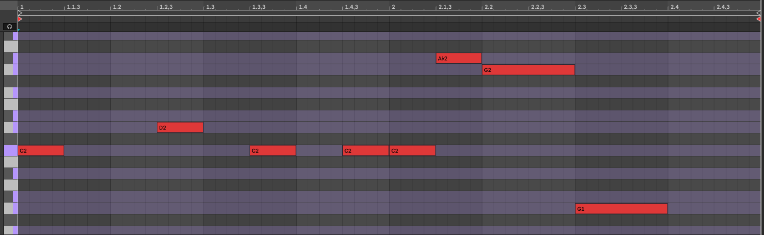
You can have a clean listen at the bassline at around 4:30 in the track.
The first bar is highly ambiguous. It plays only C and D, and does not contain a major or minor 3rd, or a leading tone, or anything that could hint us about what key it’s in. The second bar plays Ab → G, immediately destroying the mystery.
Tonal music exploits tonal ambiguity and these revelations constantly. This one is very poignant because it’s close to the absolute bare minimum required to tell this “story”: C is the tonic, Ab + G is a minor 2nd interval – which is always a huge clue for identifying key – and the D we heard earlier disqualifies Ab major/F minor, so it’s almost certain we’re in C minor. Thus, we get an extremely compact but complete tonal journey, peaking at the moment the key is revealed in Ab → G. (I am, of course, ignoring the harmonic minor scale.)
Other aspects of the bass line agree that the start of bar 2 is a peak, because they also change in that moment. The notes change from short and syncopated to legato, from syllabic to melismatic. The Ab note is unique for fading in rather than starting abruptly, and it’s a significant rise in pitch.
If you’re willing to associate some anthropomorphism to a sound, you’ll understand my claim that the synth has a total “change of behaviour” in the second bar.
Going back to the speech analogy: we control multiple properties of our voice simultaneously, such as intensity, pitch, speed and, of course, the content itself. The same sentence delivered as a plain statement, as a question or as an exclamation may register differences in many of these metrics. These properties are crucial for conveying meaning.
Computers and synthesizers provide very detailed control over sound, but through parameters that are not necessarily a 1-to-1 mapping with the sonic properties that we naturally identify as meaningful. These electronic instruments can fool one into thinking that one change is done by changing one thing. In this case, we can’t really say that the C&R consisted of a pitch change, or melodic change, or timbral change. It really was a change in character, one that can then be deconstructed as the sum of several variations (decontextualising them in the process).
I had a few other tracks in mind for this category, but my interpretation of all of them could be summed up to the same thing - melody, automation and modulation working together to make gestures in every direction, up and down, in and out, to and away from tension and release. I didn’t bother to write them.
Closing note
I mentioned this in passing, but I wish to reinforce that this is an a posteriori exercise. It’s likely that none of these tracks were composed with any this in mind. Most of them ended up like this through trial and error, serendipity, intuition, and maybe even in spite of attempts achieve the opposite.
Enjoying music is a visceral experience, you know if you like something just from listening, not based on successful application of prescriptions. This is not just a defensive stance; my goal really was only to extract possible composition techniques to help my own music. Even if it involves totally misinterpreting all of the music I like. I don’t dare even guess the authors’ intentions when making their music, but I do want to extract patterns and play with them.
Anyone who makes music probably performs this exercise to some degree, although it goes unnoticed or unregistered because music is an abstract communication system, making it excruciating to put to words. Human physiology may offer a believable explanation for why we play our most melodic instruments in the human vocal range, but you’d be hard pressed to explain in detail why you prefer a sawtooth wave over a square wave for your bass line. Nonetheless, musicians have developed great musical instinct and relied on it alone to make fantastic music, and I believe that will remain the best way to do it.


